By Picaluna Team
There is something profoundly healing about turning toward death with open hands and hearts. In the rawness of loss, creating together, with paint, memory, and presence, can become a way to stay connected, express love, and begin to say goodbye.
Decorating a coffin isn’t just art; it is ritual and active mourning. It allows families to shape the container that will carry their loved one, not only in death but also in meaning, memory, and story. It offers something tangible to do in the face of the unthinkable.
This beautiful account from one family speaks to how cathartic and connective this process can be. Through colour, symbolism, and shared time, they created a vessel not just for their mother’s body but also for their love, their grief, and their lineage. The work they completed together is real, human, and it is heartbreak made visible.
We’re honoured to fully share their story below, with deep gratitude for their openness.


“Decorating Mum’s coffin was truly a powerful experience – it was cathartic and profound. We chatted, we cried, we listened to music, we held space, and told stories.
Everyone should do this. It completely changes a simple cardboard cremation coffin into something personal and profound.
I wanted to share this beautiful artwork we created, because I know Mum would have been so proud of it and would have wanted to show our work to the world.
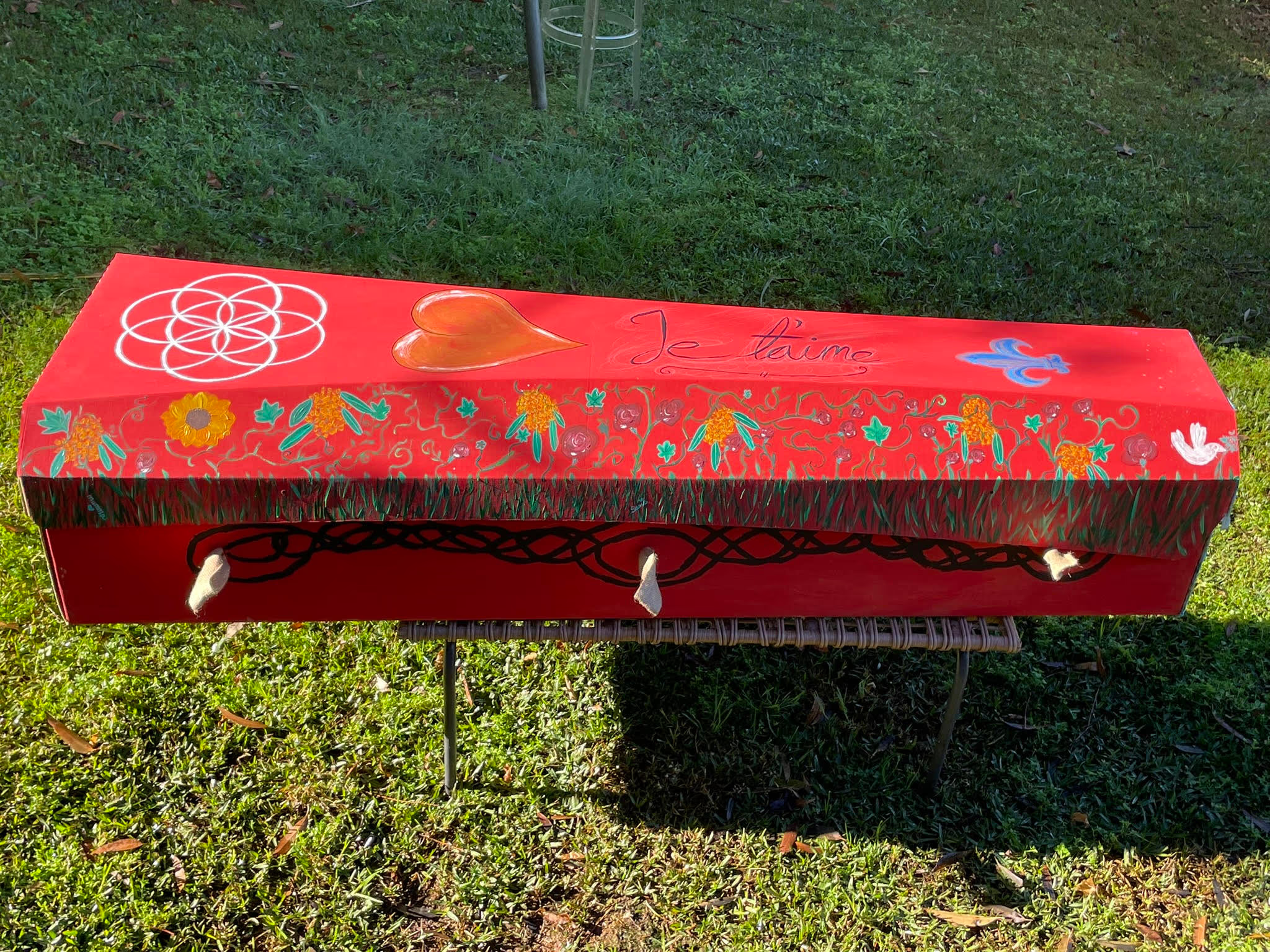
At the head of the coffin is a beautiful glowing yellow. My fiancée has synesthesia and saw these colours emanating from Mum while we were at her bedside.
The family tartan is at Mum’s feet, so she’s grounded in her Irish heritage. There are two peace doves on either side, holding a sprig of olive each and a garland of holly. With roots in the Old Testament, this is a nod to our Jewish heritage.
A bottle brush, wattle, roses, ivy, and a sunflower are part of the side garland. The Australian natives grew in the front yard of our family home – they were gifted to Mum as saplings when she became an Aussie citizen. The roses, ivy and sunflower represent Mum’s upbringing and family in England. We included grass below the flower garland as a nod to being barefoot in the garden as kids and resting in eternal meadows in our passing. Our names are woven into the grass where we sat at her bedside in her final days.
Along the sides, we represented Mum’s Celtic and Germanic ancestry with a rope knot symbolising the umbilical cord and the continuing loop of connection.
At the top of the coffin is a circle pattern called “The Seed of Life”. It’s at Mum’s head to bring order to the plaques and tangles of the Alzheimer’s that caused disorder to her brain. It brings peace to the process and has symbolised death, birth, and life cycles since ancient times.
We’ve included “I love you” written in French – Mum would often incorporate this phrase into artworks she gifted us. So we gifted it in return.
A heart of gold is over Mum’s heart, and a collection of stars are at her feet.
The fleur-de-lis symbolises Mum’s British heritage and her fluency in French. It also ties in to representations of the Holy Trinity and Mum’s belief in Catholicism. It’s placed at her feet, where she was anointed with holy oils during her last rites.
A deep red base colour underlays all of the design- Mum’s favourite colour.
We couldn’t be more happy with it.
Words from Claire Smith
Photo Credit: Joel Francis