
It is very personal and deep to lose a loved one at home. But after the initial shock, there are generally a lot of important legal and practical problems. Knowing the right order of events might help you make sense of things during a time of mourning, whether the death was predicted because of a long-term disease or happened suddenly.
This book will show you what to do right away according to Australian law, how to start planning a funeral service, and how to handle the practical and financial parts of saying goodbye.
Part 1: The First 24 Hours What to Do Right Away
When someone dies at home, the “search intent” for information frequently goes from what to do in an emergency to what to do next in a business setting. A lot of individuals feel like they need to act right away, but it’s vital to remember that you often have time to relax and think things through.
1. Who should I call right now?
The initial call relies on what happened when the person died.
- If the death was expected: If your loved one was in palliative care or had a terminal disease, you should phone their General Practitioner (GP) or a hospice nurse first. They need to officially “check” the death.
- If the death was unexpected: Such if it happened suddenly, by accident, or you don’t know what happened, call 000 right once. The operator will send paramedics and, in some situations, police to the area to make sure everything is done right.
2. Should I call the police?
You should only call the police if the death was unexpected, suspicious, or an accident. In these situations, the police find out what caused the death for the Coroner. If the person died from a known ailment and was getting regular medical care, you usually don’t need to call the police.
3. How long can a body stay at home?
Once a doctor has confirmed that someone has died, there is no legal rush to get the body out of the house. A lot of families choose to keep their loved one at home for a few hours (usually between 4 and 24 hours) so that other family members can come and say their last goodbyes. This time might be quite important for grieving as long as the atmosphere is cool.
4. Is it possible for a funeral director to pick up a body without a doctor’s note?
No. It is against the law for a funeral director to move a body until the death has been confirmed. A GP or nurse can provide you with a “Medical Cause of Death Certificate” or a “Verification of Death” to prove that you are dead. If a doctor can’t sign this (such in the case of an unexpected death), the body is considered a “Coronial matter,” and the state will first arrange for transport to the Coroner’s office.
5. What is the difference between a death that was expected and one that was not?
- Expected Death: The person was getting care at the end of their life and had a fatal diagnosis. The medical method is simple and only involves the GP and a funeral director.
- Unexpected Death: This might happen when someone dies suddenly from a medical condition, an accident, or hasn’t seen a doctor in a while. The Police and the Coroner must work together to find out what caused the death legally.
6. Who signs the death certificate?
The GP certifies the Medical Cause of Death Certificate for a death that was expected. The Registry of Births, Deaths, and Marriages issues the “Official Death Certificate” later on for legal and estate purposes. Your funeral director normally does this for you.
7. What should I do first? (The List)
- Check the Death: Call your GP (if you expect it) or 000 (if unexpected).
- Tell Family: Get in touch with close family members.
- Check for organ donation: This is time-sensitive.
- Find the Will: Look for directions for the funeral.
- Get in touch with a funeral director: Once the paperwork is done, set up transportation.
- Take your time: There’s no need to rush into making any decisions about the body right now.
Part 2: Making arrangements for the funeral service
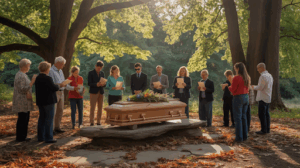
After the first legal steps are taken care of, the next step is planning a funeral service. The modern funeral service has changed a lot in Australia. A lot of people still favour conventional religious ceremonies, but more and more people are choosing “Life Celebrations” that take place in places like gardens, community halls, or even local surf clubs.
What the Ceremony Means
The first thing you should do when you start preparing a funeral service is to ask yourself, “What would they have wanted?”
- Traditional Service: This is usually held in a church or chapel and follows a predefined liturgy or framework.
- Memorial Service: This service takes place after the burial or cremation, sometimes weeks later, to give guests who have to travel more time to get there.
- Graveside Service: A small, private gathering at the cemetery for the last burial.
Personalisation and New Trends
Personalisation is the most important part of preparing a funeral service ceremony these days. This could mean:
- A “Photo Reflection”: A computerised slideshow that plays their favourite music.
- The Eulogy: A detailed account of their life, usually given by a family member or a professional civil celebrant.
- Themed Farewells: Things like “bring your own flowers from your garden” and “colourful dress codes” make the occasion feel true to the person’s essence.
Part 3: How to Get Around Budget Funeral Services
We know that the cost of a funeral can be a big problem. Funerals in Australia can cost between $4,000 and $15,000 on average. But there are a lot of budget funeral services that can help you say goodbye in a respectful way without breaking the bank.
Smart Ways to Cut Costs
Here are some alternatives for budget funeral services:
- Direct cremation: The cheapest choice. There is no official chapel service before the cremation. Families typically have their own private memorial at a park or beach later, which cuts down on the cost of the site and the professionals.
- No-Frills Packages: A lot of funeral homes offer low-cost services that include a simple, eco-friendly coffin, transportation, and the paperwork that has to be done.
- DIY memorials: You can save thousands of dollars by separating the “celebration” from the “disposition” (the burial or cremation). A wake at home or at a local community centre can feel more personal than one at a commercial funeral home.
Clear Pricing
Always ask for a “Key Price Confirmation” or a line-item quote when looking for budget funeral services. Australian directors who are honest must be open about their fees, including “third-party costs” that are not under their direct control, like as cemetery fees or cremation licenses.
Part 4: What the funeral director does
A funeral director is more than simply a planner; they are your advocate when you are most vulnerable. When planning a funeral service, they take care of all the “behind the scenes” details that would be too much for a family in mourning to handle:
- Legal Registration: They tell the state about the death and register it.
- Mortuary care: They make sure the body is ready with respect and dignity.
- Coordination: They work with the crematorium, the florist, the celebrant, and the newspaper to make sure that notices go out.
A skilled funeral director will make sure that all the legal requirements are satisfied perfectly, even if you choose budget funeral services. This will give you piece of mind that all the “red tape” is taken care of.
Part 5: Last-minute details and help
As you finish making the plans, keep in mind that organising a funeral service is a long process, not a short one.
Required Paperwork
You will need to give the following information to register the death and plan the funeral:
- The full name and date of birth of the person who died.
- Place of birth and how long you have lived in Australia.
- Job during their professional life.
- Information on any marriages and kids.
After the Service: Help with Grief
The days after the funeral service might be the hardest and quietest. GriefLine and Beyond Blue are two groups in Australia that give help around the clock. Your funeral director can also typically point you to local groups that help those who are grieving.
Checklist for a Respectful Goodbye
- Check Intent: Did the person who died have a will or a pre-paid plan?
- Make a budget that makes sense: If you don’t have a lot of money, look into budget funeral services.
- Choose a Place: Make sure the location fits the person’s personality.
- Finish the guest list: Tell your friends through social media or regular announcements.
- The Wake: Plan a modest get-together to share tales and support each other.